How i built Nowhere and what I learned about AI.
I'm a creative lead in big tech. For years my job was communication for products that already existed – someone else built the thing, I figured out how to talk about it.
A few months ago I decided to do the opposite. Build a product myself, from zero, with AI as my only engineering partner. A few months later I have an app in the App Store with my name on it. Here's what I hit along the way, and what I'd tell myself before starting. Maybe this will be useful if you're just getting started.
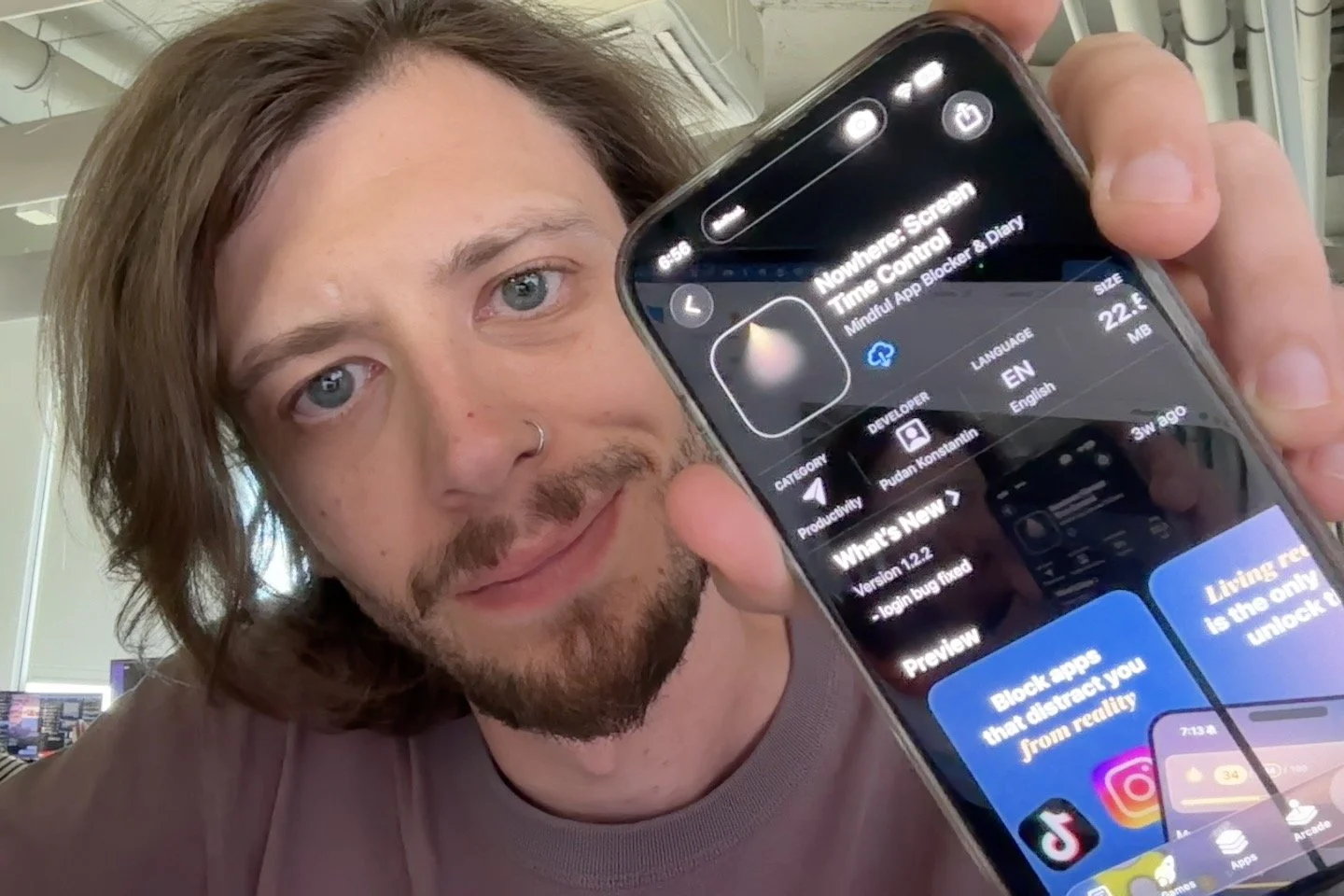
And yes, this is me taking a picture after the release.
The wall has fallen
It used to be: you have an idea, you hit a wall, because you can't write the code. I faced it endless amounts of times and almost quit fantasizing. That wall is mostly gone now. The idea itself became the tool – you describe it, the model builds it.
Which means creative thinking is your actual asset now, not a soft skill next to the real work. If you can come up with something and describe it precisely, you can already build. This wasn't obvious before, because code used to level everyone down to the same starting line.
Concept or mechanic – pick your starting point
Here's the first real fork: do you start from the mechanic or from the concept? Mechanic times concept equals product. Miss the mechanic and you have a nice idea with no shape. Miss the concept and you have a working prototype nobody cares about.
I renamed the same app five times before I got this right: Step4, SpaceControl, DOOM CTRL, Resistance, Nowhere. The mechanic never changed – real-world activity converts into access to your phone. What changed was my understanding of why anyone would care.
Step4 was mechanic with no story. DOOM CTRL had mood but too narrow a frame. Nowhere clicked when I stopped thinking about blocking a screen and started thinking about pulling someone back into their actual life. "Now here" – the wordplay carries the whole concept. But this never stopped me from building on the core mechanic.
The main thing I learned: don't stop doing what you can do just because you haven't found the right idea yet. The process and momentum will bring you there.
From briefs to thesaurus to meme
There are two ways to talk to a model. One is guesswork: "make the screen look like this." It sounds like an instruction, but it's a bet – the model guesses, you guess, the result is a coin flip.
The other is a brief: vocabulary plus behavior. You define your terms upfront and the rules the product follows. The model stops guessing and starts working inside your coordinates. This vocabulary can include words like "the red button," "the top block," or even "the Six Seven." The model will name them properly in the code, you don't need to remember how. But when you describe the same elements over and over again in different words, the model may miss the point.
Plus there is also a lot more fun in the process to name things like that. In some way it becomes a meme between you and AI. Weird, but joyful.
UX first, UI later
Do the logic before the look. UX is the sequence – what happens, in what order, what the user sees at each step. There are millions of apps and tens of millions of good designs on the internet that follow the same basic rules, and people are used to them. No need to build it from scratch when you can just say "edit the screen to follow the best UX practices and Apple standards."
But with UI, it's different. Color, style, polish need extra time and effort. AI will generate basic shapes in the right places, but nothing impressive.
Function first, then it gets dressed.
Building a visual style without opening Figma
This is the part people ask about most. How did I do the frontend without Figma, tokens, shapes and other things?
I pull references for screens and images from Pinterest, run them through AI to make an MD file, then mix these files all together prompting what I liked in each one of them. This is like a palette which mixes colors, but the colors are words and the palette is a black box.
When I was done I applied this freshly made written design to the first page of the project and tweaked it from there until it resonated. Later this system was applied to the other screens. And when you see something not only functional but actually unique and colored the way you wanted, new ideas and mechanics start appearing faster than clouds in the mountains.
The part I got wrong: distribution
Building the app was the easy half – maybe fifteen percent of the actual effort. Distribution is the other eighty-five.
This is what I underestimated. Getting a working product out of a model is genuinely doable now. Finding people for it is a separate job, and you can't push it to later. "Just build it" with no thought for who sees it gets you an MVP that needs a rebuild, not a product. Think about distribution from day one, not after launch.
In fact I was thinking about writing a whole new article on what I learned from this process and how I screwed up three times in a row.
Naming matters less than you think
Even though the name is important in a conceptual way to shape the whole idea of the app, it can be almost anything. "Nowhere" is not a unique name in the store at all. What matters is how you explain the point in three seconds.
Nowhere tells you nothing by name. By substance it's screen time, focus, digital wellbeing – a category people actually search for. Look at how competitors in that category position themselves. Don't copy the name. Copy the logic behind how they phrase it.
Don't let go of the wheel
Don't hand everything to the model. Review with the expensive models, more than once. The vocabulary and architecture you set at the start aren't a one-time setup – they're what the model leans on the entire way through.
Vision and decisions stay yours. The model executes, you decide. And think about marketing and budget before launch, not after. An audience gets built ahead of time – it doesn't appear the day you hit release.
Start this week
Five things, in order:
First prompt – there is nothing easier to start than to ask AI how to start. Just do it.
Mechanic – what exactly will the app do. I doubt anyone can develop anything not ever seen before. So just research what interests you personally and jump into it.
Vocabulary and briefs – start forming a vocabulary as a skill and make AI fill it up when you use the same words a few times. And use those words to explain exactly what you need.
Concept – think about the story you're telling. Make it personal, there are already too many generic functioning apps with huge budgets. You can't compete with them as an indie.
Style from references – don't draw it, collect it and hand it to the model.
The barrier used to be code. Now it's the idea. You already have what you need to start.
Next up: what I got wrong about marketing, and what I'd do differently if I were starting today.
